
We use cookies to improve this site and see how it is used. Cookies Policy

Skip to content
ไทย

Laboratory Glassware

Borosilicate glassware from Duran and Pyrex, including beakers, Erlenmeyer and volumetric flasks (Class A), measuring cylinders, round-bottom flasks and laboratory bottles. We supply universities, schools and labs across Thailand, and quotations are free.

TL;DR

Laboratory glassware from Duran and Pyrex

We supply borosilicate 3.3 laboratory glassware in Thailand from Duran and Pyrex: beakers, Erlenmeyer and round-bottom flasks, Class A volumetric flasks, cylinders and GL 45 bottles. For a replacement part, send the assembly model and joint size so we can check the fit. Every item is quoted on request, singly or as a set.

125 products · page 2 of 3

Weighing Bottle Low Form D.50 x H.30 mm, 45 ml

Weighing Bottle Low Form D.50 x H.30 mm, 45 ml

MX-10869

Weighing Bottle, Tall Form D.30xH.50 mm.

Weighing Bottle, Tall Form D.30xH.50 mm.

MX-10868

MST-CUP-KLAXON MST Beaker Cup (YHKU0400)

Klaxon

MST-CUP-KLAXON MST Beaker Cup (YHKU0400)

MX-10131

P811613 Glass Vacuum Filter Holder

Favorit

P811613 Glass Vacuum Filter Holder

MX-10546

Pouring Ring Seal PP GL45 (Blue) #2924228, Duran

Duran

Pouring Ring Seal PP GL45 (Blue) #2924228, Duran

MX-10866

Screw cap PP. Blue GL45 #2923928, Duran

Duran

Screw cap PP. Blue GL45 #2923928, Duran

MX-10867

Rubber Bulb for Auto Burette

Rubber Bulb for Auto Burette

MX-10955

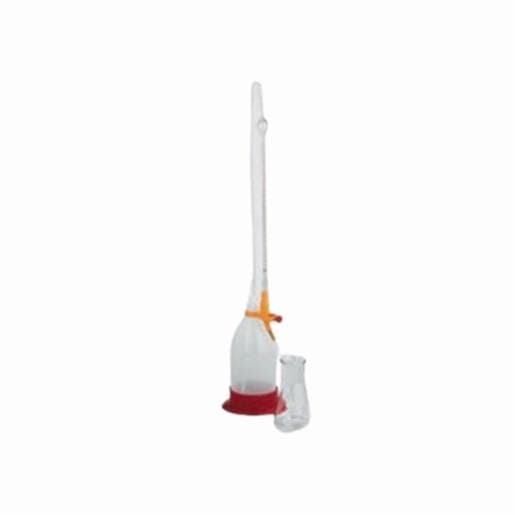
Funke Gerber 4520 Buret

Funke Gerber

Funke Gerber 4520 Buret

MX-17288

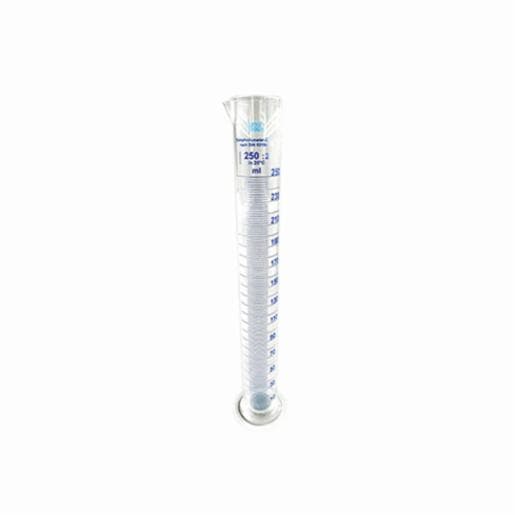
Funke Gerber 7661 Cylinder

Funke Gerber

Funke Gerber 7661 Cylinder

MX-17301

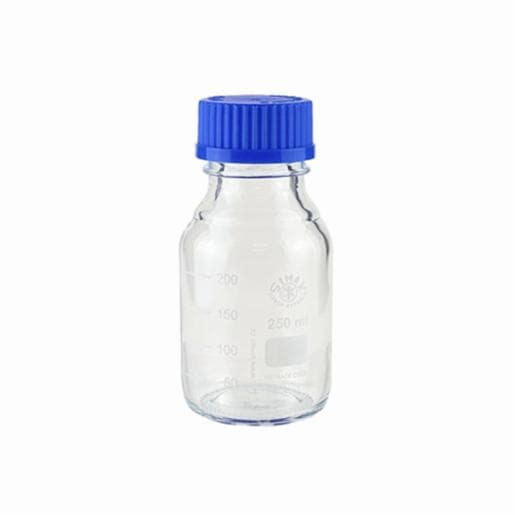
Funke Gerber 8971 Bottles, Jars & Jug

Funke Gerber

Funke Gerber 8971 Bottles, Jars & Jug

MX-17305

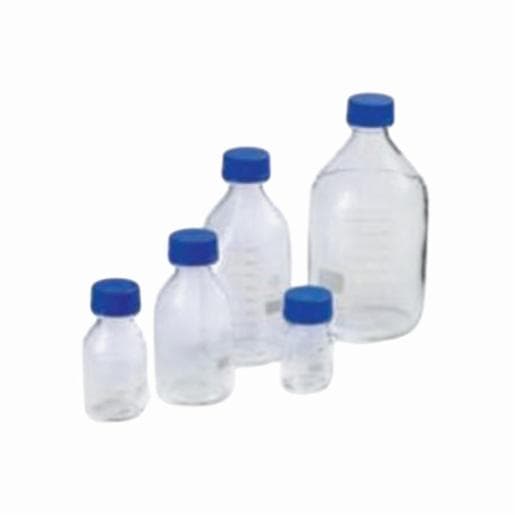
Funke Gerber 8972 Bottles, Jars & Jug

Funke Gerber

Funke Gerber 8972 Bottles, Jars & Jug

MX-17306

Funke Gerber 8973 Bottles, Jars & Jug

Funke Gerber

Funke Gerber 8973 Bottles, Jars & Jug

MX-17307

Buyer guide

How to specify laboratory glassware

01

Glass type

Borosilicate 3.3 (ISO 3585) is the default for heated and chemical work: low thermal expansion, so it takes the oven, the autoclave and a hot plate without cracking, and it resists acids and most solvents. Soda-lime glass costs less and is fine for storage and single use, not for heating. Strong alkalis and hydrofluoric acid attack every glass; those jobs go in PP, PTFE or PFA.

02

Volumetric class

Anything that measures a volume carries a tolerance class. Class A (ISO 1042 flasks, ISO 4788 cylinders, ISO 648 pipettes) is the tighter tolerance and the one accredited and GMP laboratories specify; class B allows roughly twice the error and fits general preparation. Ask whether a batch certificate or an individual certificate is required, because that decides the item, not just the paperwork.

03

Form, thread and joint

Bottles are sold by thread: GL 45 is the laboratory standard, GL 32 and GL 25 the narrow necks. Flasks and adapters are sold by ground joint: NS 14/23, 24/29 and 29/32 must match the glassware they connect to. Beakers come low form and tall form; cylinders come with a hexagonal or a round base. Name the standard, not "like the old one".

04

Temperature and chemical limits

Borosilicate 3.3 glassware is routinely autoclaved at 121 °C and dried at 200 °C and above with the cap off. The cap and pouring ring set the real limit: polypropylene caps to about 140 °C, PBT to 180 °C, PFA higher. Vacuum work needs thick-walled filtering flasks and desiccators, never a standard bottle.

05

Certificates and traceability

Class A ware should carry a batch number and, where the method demands it, a certificate for that batch or item. Laboratories accredited to ISO/IEC 17025 usually record the lot on receipt; say so in the request so the supplier ships certified lots rather than open stock.

Include this in a glassware request

  • Item, capacity and form, for example beaker 500 mL low form, or volumetric flask 100 mL.
  • Glass type: borosilicate 3.3 or soda-lime, and plastic where glass is unsuitable.
  • Tolerance class for volumetric ware, A or B, and whether a batch or individual certificate is needed.
  • Thread or ground joint size: GL 45, GL 32, NS 24/29 and so on.
  • For replacement parts: assembly brand and model, part code, connection dimensions and the pieces needed.
  • Quantity per item and the pack size you can accept.
  • Brand preference, or an equivalent-accepted note with the standard the item must meet.
  • Delivery site, and whether autoclaving or dry heat is part of your process.

Common laboratory glassware questions

Can I request only the flask from a filtration set?

Yes. Send the assembly brand and model, the part code if known, flask capacity and connection dimensions. Identify whether you need the receiving flask alone or also the funnel, support, clamp, stopper or adaptor. Capacity alone, such as 2 L, does not confirm fit or suitability for vacuum use; separate-part availability must be checked for that assembly.

What is the difference between class A and class B glassware?

Both are volumetric tolerance classes defined in the ISO standard for each item type. Class A is the tighter tolerance; a 100 mL class A volumetric flask is allowed roughly half the error of a class B one. Class A is what accredited, pharmaceutical and food-testing laboratories specify for standards and dilutions; class B is enough for general preparation. Class A ware normally carries a batch number and can be supplied with a certificate.

Are Duran and Pyrex the same glass?

Both laboratory lines are borosilicate 3.3 to ISO 3585, so for chemical and thermal resistance they are interchangeable in most methods. The differences sit in the range, the closures, the markings and the certificates each maker offers for a given item. When a method or a validation names a brand, keep it; otherwise specify the standard and let the quotation compare equivalents.

How do I tell whether a piece of glassware is class A?

Look for the class marking on the item, an "A" printed with the standard such as "ISO 1042 A", the stated tolerance as a ± value at 20 °C, and a batch number. Class B ware is marked "B" or carries no class. A certificate refers to that batch or serial number; a certificate without a matching number on the glass proves nothing.

What does GL 45 mean on a laboratory bottle?

GL is the ISO thread designation for glass bottles and the number is the outer thread diameter in millimetres, so GL 45 caps, pouring rings and adapters fit any GL 45 bottle regardless of maker. GL 32 and GL 25 are the narrow-neck sizes. Buying by thread size is what keeps caps and dispensers interchangeable across brands.

Related lab guides

Sources

Glass properties and tolerance classes follow the published standards and the manufacturers' technical pages. The limits of a quoted item are checked on its own data sheet.

Specifications, compatibility and supplied documents vary by model and option. Check them against your method and the current manufacturer data sheet before ordering. Supplying equipment does not validate a method or certify compliance.